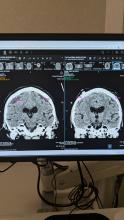
Head Trauma

I think we got to the bottom of what was going on in my last post. That was on Friday, Aug 7, about my left shoulder. Three weeks later, on Tuesday the 28th, I felt like I was having a stroke while driving home. My left arm felt weak, numb, and lacking control. I had Pattie take me to Queen’s ER. They quickly ruled out a stroke, did a CT scan and an MRI. Doc asked if I had any recent head trauma. I told her about my crash. She said the MRI revealed bilateral subdural hematomas, and that I qualified for  bed. Yay!

Tags

More on my crash and wonky left shoulder.

My last post was about a weakness I felt in my left wrist and arm on long bike rides. I had to stop and rest every thirty minutes or so. My legs were fine. My fitness was fine. I just could not control the bike. I also said that this is something I have felt for years. Even so, I was puzzled why it had gotten so much worse. My thinking was that when I crashed my TT bike in May I landed on my left shoulder and strained a bicep tendon.

Assess and refocus

Last November I wrote about choosing a BHAG - Big, Hairy, Audacious Goal. Something that scares you to consider. Something that at times seems terrifying. The kind where you wake up at two o’clock in the morning asking yourself, “What was I thinking?” By January I had mine. Ironman 70.3 Hawaii in May, and, the big one, Ironman California in October. Honu was a DNS. Why? A couple of reasons. The most immediate was that I crashed my bike two weeks out and was in no shape to race. The rest I’ll explain later.

Honu remains out of reach

Sunday was my last long ride before Ironman 70.3 Hawaii, known as Honu. I felt great. Lots of power. Comfortable on the bike. A moment's inattention and suddenly there was a parked car right in front of me. I thought I might hit it. I swerved, congratulating myself for missing it as I whizzed past, only to feel the bike go out from under me. TT bikes do not handle well in the aero position.

Don't Screw It Up

If there is one piece of advice I would give to athletes and coaches as a race approaches, it is this: “Don’t screw it up.” I borrow that phrase from the great ultrarunning coach Jason Koop.

The temptation to do “just a little more” can be overwhelming. Longer long rides. Harder swim sessions. More frequent running. Or maybe a small, local race that looks like fun. Why not?

Tags

Dealing with Injury

Last time I wrote about spending some workout time going fast. At least race pace, maybe faster. I used the term intensity a lot and this could be confused with going hard – running or biking uphill, for example. What I meant was getting comfortable moving the body faster. Running, in particular, because the running stride involved so many muscle contractions that must be coordinated perfectly in order to run efficiently. I ended that piece by mentioning the increased risk of injury.

Rethinking Intensity

My introduction to running was by way of a Couch – 5K plan I found on the Internet, followed up with a beginner's marathon plan by the great Hal Higdon.  

Soon after that I came across Matt Fitzgerald and his 80/20 plan. Slowing down sounded like a good idea, so I went with that. It was through Matt that I discovered Dr. Stephen Seiler, credited with formulating 80/20 training. At some point I learned that Joe Friel was another Seiler fan. He was the one who said that too often athletes make their easy days hard and their hard days easy.

Haleiwa Metric Century Ride Cancelled

The recent pair of rain events caused flood damage throughout the state. Especially hard hit was the Waialua-Haleiwa neighborhood. Road damage resulted in significant impact on the safety of the annual Hawaii Bicycling League Haleiwa Metric Century Ride, particularly at Waimea Bay. HBL did the right thing by taking the riders safety into account and cancelling this event. But decisions like this go beyond the immediate impact.