It’s been a long time since I felt good about my race results. At last, with this edition of the Honolulu Marathon, I can say I am delighted with my results. Not exactly what I planned for, but remarkably close, and how often does a race go as planned?
The finishing time tells part of the story, the easy part. What is not so obvious from the data is how I felt. Energetic all the way to the finish. For the entire second half I was passing people. Everyone I came upon. That has never happened before. Usually I fall in with a group going my pace and just hang with them, or struggle along while everyone passes me. Not this time. I felt amazing.
Things did get off to a rocky start. For the first 10k I was going great, following my plan. When I started the climb up Diamond Head I changed to a steady walk, as planned, but kept the effort high. After a minute I suddenly felt dizzy. I backed off, tried again, got dizzy again. Not tired. Not out of breath. Good legs. Just dizzy. I crossed over to the other side of the road, sat on a ledge overlooking the ocean, and texted my wife that I was considering pulling the plug.
In early 2020 I started having occasional heart issues on training runs. HR 150+ right at the start of the run, dropping to 110 as soon as I started walking. I thought my Garmin was wonky, so I replaced the strap. No good. My GP referred me to a cardiologist, who is also a runner, and after a bunch of tests I was diagnosed with SVT, treated by changing from amlodipine to losartan. Big improvement, as losartan relaxes arteries to increase blood flow and lower blood pressure and can help regulate SVT. In the end, there was no race that year due to the lockdown.
It took a long time to get that diagnosis, in part because everything was closed. By the 2021 marathon we were still tweaking the heart thing. My training runs were all normal, but on race day it appeared as I approached the 10k mark. I did not want to die out on course so I abandoned at the park.
I have a hypothesis that what happened this time was another manifestation of my heart issue. That when my effort got too high for too long, blood flow to the brain dropped too low and I got dizzy. I think stress is a factor, as this condition has appeared almost exclusively at races, not counting the beginning when it was not treated. A problem with this hypothesis is that it will be difficult to prove.
My plan going forward is to do more strength training along with more muscular endurance training. I have good aerobic conditioning. This race proved that. If I can manage to make hard efforts a little less stressful I might be able to perform better. Who knows, there still may be room for cardio-vascular improvement as well.
Back at the race, I gave myself a little pep talk. I remembered what Matt Fitzgerald wrote in How Bad Do You Want It. What Jason Koop wrote about quitting in his book Training Essentials for Ultrarunning. Not to mention the DNFs I have been collecting. I decided to get back out there and do the best I was capable of, even if it meant blowing up my goal finishing time. You could say I had to set my ego aside.
About that finishing time. My goal was to get under 9:00. I did 9:12. Here are some highlights to put that in perspective. I have twelve starts and one DNF.
2012 7:51, first marathon, age 61
2014 7:26 PB
2021 DNF, heart, SVT at mile 6
2022 8:50
2023 10:12 Bad fuel and hydration plan, dehydrated, puking slime, barley finished
2024 9:53 High humidity, avg 88, max 100F
2025 9:12 Heavy rain, avg 83F, max 93F
Who would not be pleased by taking forty minutes off their previous time, and a full hour off the year before that? But again, how I felt was what mattered most.
Race Plan
Run/Walk 4/1
Walk first 5, run really begins on King Street
Walk steep hills (Diamond Head) mile 6-10 and 24-25 and where necessary due to crowding
Pace by RPE, occasional check HR to make sure it is sane
Do not react to runners around me, run my race
Be positive, thank police and volunteers, supporters, keep it fun
Fuel and Hydration
Do not rely on what is on course, run through aid stations except for water refill
Osprey 1.5L bladder with Precision Hydration 1000 mix.
8 packets of PH1000
4 PH 90g gels (screw on cap)
2 PH 30h caffeine gels
Carry disposable bottle with PH1500 to start line, sip to stay hydrated
Sip of sports drink at the start of every walk period, refill the bladder appx every 2 hrs as needed.
Add a sip of gel every other walk period, consume one pack appx 2 hrs.
Take caffeine gel around Kahala Aloha Gas Station out and back, mile 11 and 20, as needed.
Conditions
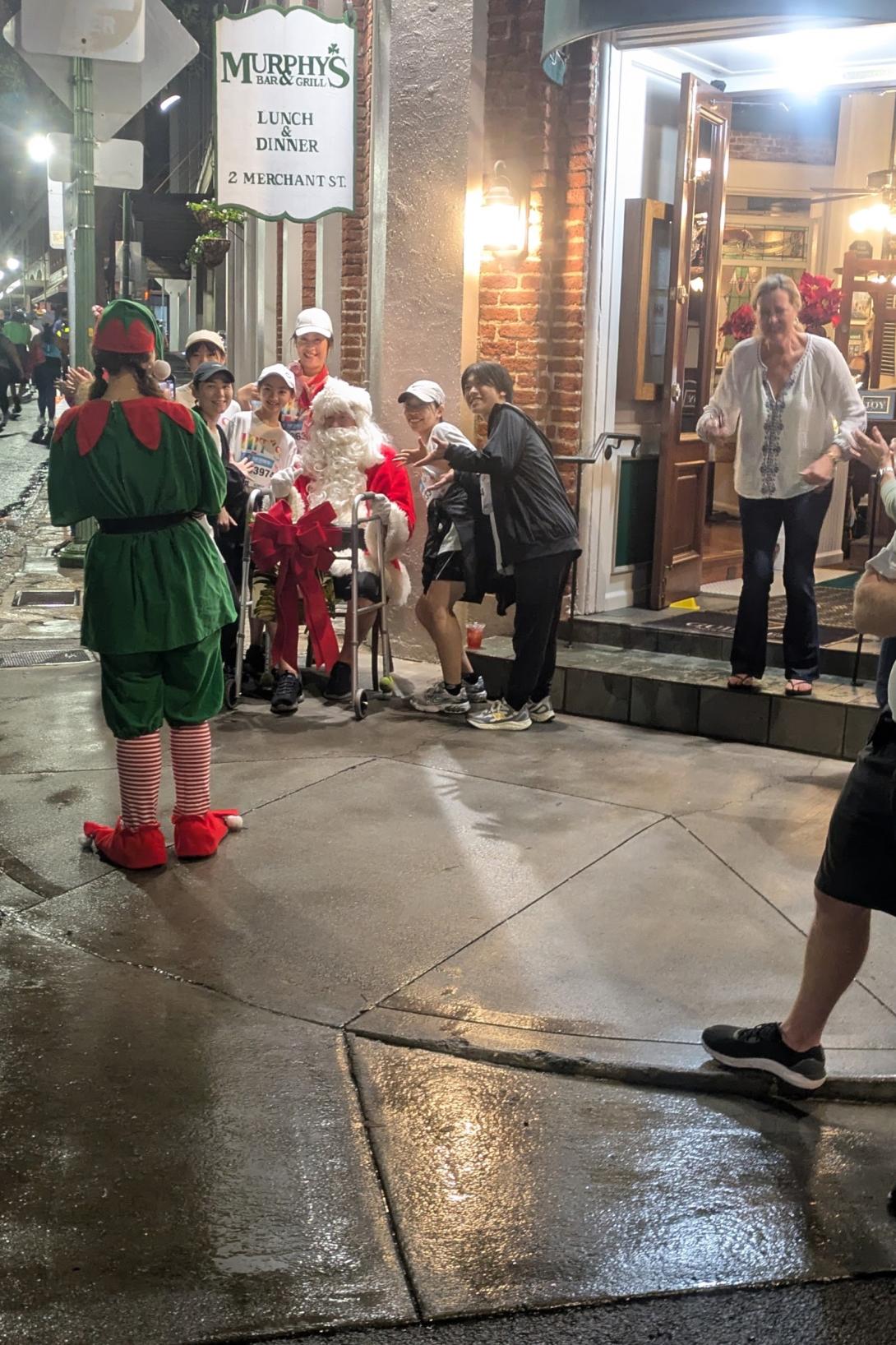
This was a wet race. Flood warnings the night before. Heavy rain at line-up time. Shoes and socks soaked from the start. A break just before the start but the rain returned after a couple hours and was relentless. At times I just laughed at how ridiculous it felt to be out there. The finish area at Kapiolani Park was a mud bog. The organizers canceled the Monday activities to prevent further damage to the grass. It rained all Sunday night and Monday morning. If you know Hawaii, you know how unusual that is. We have passing showers, not rainy days.
As I was packing on Friday I threw in a few PH1500 packers to use in place of the PH1000. I only trained with PH1000 and did not want to switch completely, so my plan was to switch in some PH1500 as needed. My thinking was that the rain would significantly reduce my hydration needs, which might lead to my electrolytes to drop too low. In the end my hydration did go well below plan. I only refilled three times, and the last two were PH1500. Seemed to work well.
After around mile 20 I was beginning to feel a little bloated so I switched from a sip of water every five minutes to every ten. That is, every other walk break began with a sip of water, a sip of gel, and a little more water to wash down the gel. I never did take the second caffeine gel. Also interesting, I have never peed at a marathon before. This time I felt a gentle urge around half way and dove into a porta potty at the entrance to Hawaii Kai, roughly mile 15. The color was not too bad!
My feet were not so good. I started to feel a little discomfort after the rain returned. When I removed my soaking wet shoes and socks after the race I discovered red blisters on both soles, at the widest part. I’m still hobbling around.
Technology
In the past I would pace myself using a Stryd power meter. For this race I went by RPE. I planned on using a 4/1 run/walk, and did up until Diamond Head. In training I tried 9/1 but the run was too long to be helpful, and I know from experience that a longer rest makes restarting the run harder. I wondered why Garmin did not include a data screen for that. It was not until the race, when I was scrolling looking for time of day, that I discovered Garmin had added one. I left that on throughout the race.
Battery life used to be an issue. There were times when my Garmin ran out of battery before the end of the race. I always disabled Bluetooth. Now, my FR965 finished about half full. Amazing!
My Google Pixel 7a phone did not fare as well. It is old. It has been dropped a few times. I never had an issue until this race. The long soak affected the touch screen. Now it acts like it's haunted. I need a reliable phone for those long training days, so a replacement is on the way.
Why this race was important to me
After a few good years of running, and then triathlon, my wife and I began a series of medical challenges that disrupted my training quality and my ability to perform. I have already mentioned my heart issues. My wife’s hip went out when we landed in Kona for Ironman 70.3 Hawaii, a.k.a Honu. She couldn’t walk. I DNF’ed the swim. Turned out not to be life threatening, but it was serious. She needed hip replacement surgery. That wiped out Ironman Cozumel. I had cataract surgery. She was diagnosed with cancer and underwent a tough series of chemo. I had a hernia. And, last but not least, last winter, almost a year ago, I was diagnosed with prostate cancer. In May I returned to the Big Island for another shot at Honu, but I was not ready and really messed up the swim. This marathon was an opportunity to prove to myself that I could perform. It did just that. A sorely needed boost in my confidence.
If you would like to learn more about the athlete’s heart, there is no better resource than The Haywire Heart, a book by Chris Case, John Mandrola, and Lennard Zinn.
I would be remiss if I did not thank the people who consistently help me get through this race every year. First and foremost, my wife Pattie, who is always there through thick and thin, and always has a delicious steak dinner ready after the race. Then there is Dr. Ric Trimillos, who generously allows us to spend race weekend at his condo, a short walk from the start line. And of course there are the many friends I see out on the course and on Facebook.
My “Why” has been “Because I still can,” a reference to my many friends who are no longer able to participate. There were times out there when I thought I might need to change that to “Because I can still try.” This result shows me I still can.